EU AI Act and prompt governance: what AI teams need before August 2026
The EU AI Act high-risk deadline hits August 2, 2026. Articles 11, 12, 13, and 14 require audit trails, versioned documentation, and human oversight that apply directly to prompt management. What the regulation requires and what compliance looks like.

TL;DR: The EU AI Act's high-risk obligations take effect August 2, 2026, and the requirements for logging, technical documentation, transparency, and human oversight apply directly to how teams manage prompts in production. Most AI teams are not ready. Here is what the regulation actually requires and what compliant prompt infrastructure looks like.
If your AI system is classified as high-risk under the EU AI Act, the prompts that drive its behavior are not informal artifacts. They are part of the system's design specification. They need to be documented, versioned, auditable, and reproducible. That is not an interpretation. It is what Articles 11, 12, 13, and 14 require when read against how LLM-powered systems actually work.
Most teams building with LLMs in 2026 manage prompts in code repositories, shared documents, or ad-hoc configuration files. That worked when AI features were experimental. Under the EU AI Act, it creates a compliance gap that regulators have the authority to penalize at up to 35 million EUR or 7% of global annual turnover.
What the EU AI Act actually requires
The EU AI Act entered into force in August 2024, with obligations phased in over three years. The critical deadline for most enterprise AI teams is August 2, 2026, when requirements for Annex III high-risk systems become enforceable. These include AI used in employment decisions, creditworthiness assessments, education, law enforcement, and critical infrastructure.
The European Commission proposed a Digital Omnibus package in late 2025 that could postpone some Annex III obligations to December 2027. Prudent compliance teams are not banking on that delay materializing. The regulation is law. The enforcement infrastructure is being stood up. Each EU member state must designate at least one national competent authority with powers to investigate violations, demand information, conduct audits, and impose fines.
The core obligations that intersect with prompt management fall under four articles. None of them mention "prompts" by name. All of them describe requirements that, in an LLM-powered system, cannot be met without governing the prompts that control system behavior.
Why prompts are in scope
In a traditional software system, the behavior is defined by code. In an LLM-powered system, behavior is defined substantially by prompts: system instructions, few-shot examples, retrieval augmentation context, and model configuration parameters. A change to a prompt can alter the system's output as fundamentally as a change to source code. In many cases, more so.
The EU AI Act requires documentation of "the general logic of the AI system and of the algorithms" and "the key design choices including the rationale and assumptions made." For LLM-based systems, prompts are where design choices live. The temperature setting, the system instruction, the retrieval strategy, and the output formatting rules collectively define how the system behaves. Governing the system without governing the prompts is like auditing a codebase without access to the source files.
A 2025 research paper on operationalizing LLM governance described the architecture needed: three integrated pillars of monitoring, audit trails, and policy enforcement pipelines. The audit trail pillar specifically calls for "lifecycle versioning of models, prompts, retrieval sources, and tool calls." Prompts are not incidental to compliance. They are a primary governance surface.
The four compliance requirements that affect prompt management
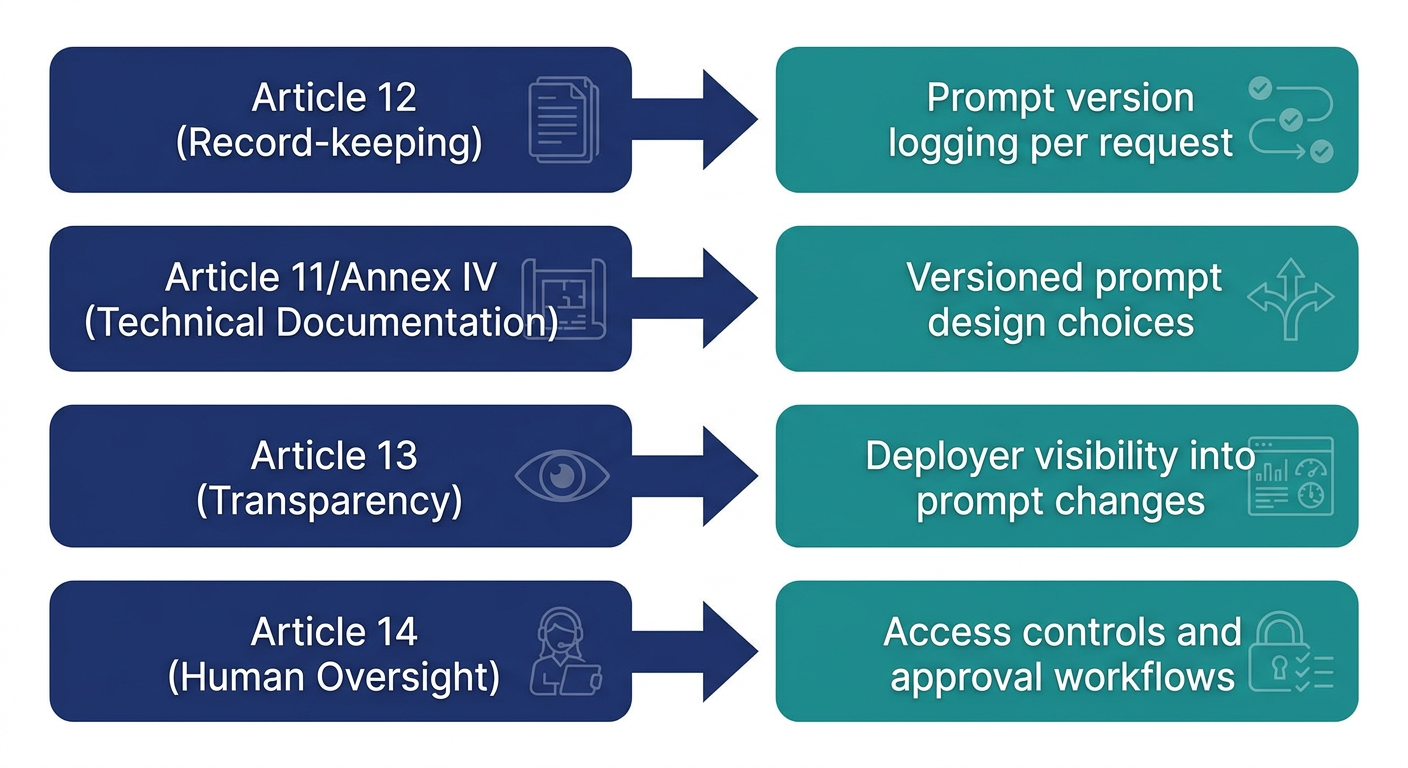
Record-keeping (Article 12)
Article 12 requires that high-risk AI systems "technically allow for the automatic recording of events (logs) over the lifetime of the system." Logs must capture events relevant for identifying risk situations, facilitating post-market monitoring, and monitoring operation. They must be retained for at least six months.
For LLM systems, this means logging which prompt version was active for each request, what input was processed, and what output was generated. If a user reports unexpected behavior, the organization needs to reconstruct exactly which prompt was running at that time. Manual prompt management, where prompts are edited in place with no version history, makes this reconstruction impossible.
The logging must also be automatic. Article 12 explicitly states the system must "technically allow" for automatic recording. Post-hoc reconstruction from memory or chat histories does not satisfy the requirement.
Technical documentation (Article 11 / Annex IV)
Annex IV specifies what technical documentation must contain. The list includes the general logic of the AI system, key design choices with rationale, specifications on input data, expected output and output quality, and decisions about trade-offs made to comply with requirements.
In an LLM system, the prompt is where most of these design choices are implemented. The system instruction defines the general logic. Few-shot examples define expected output patterns. Guardrail instructions document trade-off decisions. Temperature and model selection affect output quality. If these are not documented and versioned, the technical documentation requirement is not met.
The documentation must be "drawn up before that system is placed on the market or put into service and shall be kept up to date." That last clause matters. Every prompt change is potentially a documentation update. Teams iterating on prompts weekly need a system that tracks changes automatically, not a manual documentation process that runs quarterly.
Transparency to deployers (Article 13)
Article 13 requires that deployers receive information about the system's "technical capabilities and limitations of performance," including "specifications for input data" and "information to enable deployers to interpret the output appropriately."
When the system's behavior is substantially defined by prompts, deployer transparency requires that the deployer understands what the prompts do. If the system prompt includes instructions to decline certain request types, or to format output in a specific way, or to apply particular safety guardrails, the deployer needs to know. Changes to those prompts change the system's behavior envelope, and deployers need to be informed.
This creates a practical challenge for teams that update prompts frequently. Each significant prompt change may trigger a deployer notification obligation. Without a system that tracks which prompt versions are in production and what changed between versions, meeting this obligation at any reasonable cadence becomes operationally difficult.
Human oversight (Article 14)
Article 14 requires that high-risk systems be "designed and developed in such a way that they can be effectively overseen by natural persons." The oversight measures must be "commensurate with the risks, level of autonomy and context of use."
Effective oversight of an LLM system requires visibility into and control over the prompts. If a prompt change can alter system behavior in ways that affect health, safety, or fundamental rights (the categories the Act is designed to protect), then the organization needs access controls on who can change prompts, approval workflows before changes reach production, and the ability to instantly roll back a problematic change.
Informal prompt management, where any engineer can edit a prompt in a config file and deploy it, does not provide the oversight structure Article 14 contemplates.
What compliant prompt infrastructure looks like
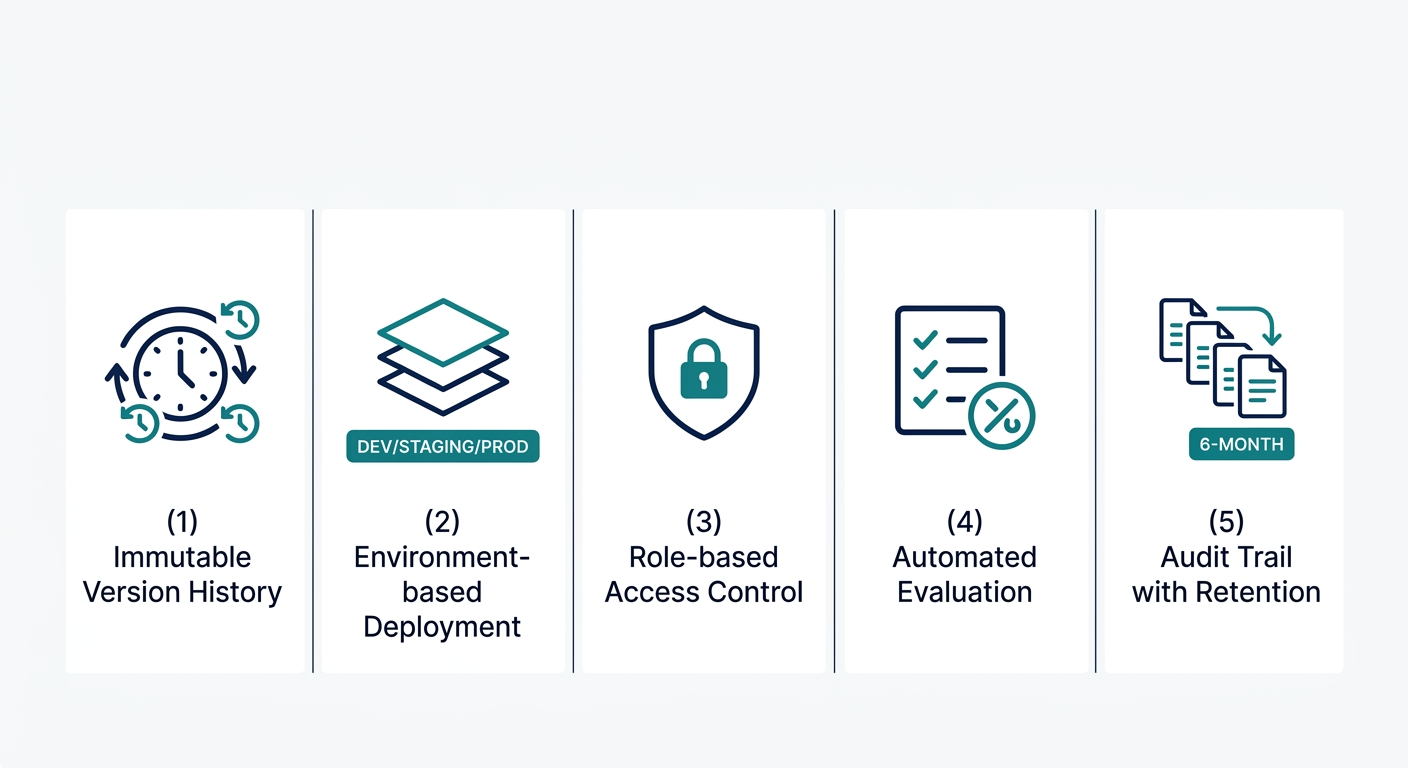
The gap between how most teams manage prompts today and what the EU AI Act requires is not subtle. Meeting the four requirements above demands specific capabilities.
Immutable version history. Every prompt change must be recorded as a distinct version that cannot be retroactively modified. This satisfies Article 12's automatic logging requirement and Annex IV's documentation obligation. The version history must include what changed, when, and by whom.
Environment-based deployment. Prompts should move through environments (development, staging, production) with explicit promotion gates. This supports Article 14's human oversight requirement by ensuring changes are reviewed before reaching production.
Role-based access control. Not every team member should be able to modify production prompts. Access controls mapped to roles (admin, editor, viewer) enforce the oversight structure the Act requires.
Automated evaluation. Before a prompt version reaches production, it should pass automated quality checks. This supports both the documentation requirement (expected output quality) and the oversight requirement (systematic verification before deployment).
Audit trail with retention. The complete history of prompt versions, deployments, and rollbacks must be retained for at least six months (Article 12's minimum). The trail must be queryable: given a specific user interaction at a specific time, the team must be able to identify exactly which prompt version was active.
Prompt management platforms like EchoStash are built around these capabilities. Version immutability, role-based access, deployment targets (dev/staging/prod), and evaluation gates map directly to what the regulation requires. Langfuse provides complementary observability and tracing. PromptLayer offers prompt versioning with request logging. The tooling exists. Adoption is the gap.
The penalty math
The penalty structure under Article 99 is tiered. Violations of prohibited AI practices carry fines up to 35 million EUR or 7% of worldwide annual turnover, whichever is greater. Other violations, including failures in technical documentation, logging, transparency, and oversight, carry fines up to 15 million EUR or 3% of turnover. Supplying incorrect or misleading information to regulators carries fines up to 7.5 million EUR or 1%.
For context, a company with 500 million EUR in annual revenue faces a maximum exposure of 15 million EUR for a documentation or logging violation. That is not the kind of risk that justifies postponing infrastructure investment until after the first audit.
Enforcement will be conducted by national competent authorities in each EU member state. The European AI Office has authority to request documentation, conduct evaluations, and demand source code access for general-purpose AI models. Market surveillance authorities can investigate deployments, order withdrawals, and levy fines.
What the data suggests
The EU AI Act is the first comprehensive AI regulation with enforcement teeth, but it is not the only one in motion. AI governance frameworks are advancing across jurisdictions, with Brazil, Canada, and several US states developing their own requirements. Teams that build compliant infrastructure for the EU AI Act will likely find that the same capabilities satisfy future regulations elsewhere.
The teams best positioned are those that already treat prompts as first-class engineering artifacts: versioned, tested, deployed through controlled pipelines, and auditable after the fact. For everyone else, the August 2026 deadline is the forcing function.
The regulation does not require any specific tool or platform. It requires capabilities: automatic logging, documented design choices, deployer transparency, and human oversight. How a team implements those capabilities is a technical decision. Whether they implement them is, as of August 2, 2026, a legal requirement.
Related links
Stay in the loop
Get notified when we publish new posts. No spam, unsubscribe anytime.